
October is the best time for skywatchers to see Saturn when the ringed planet is in opposition to us.
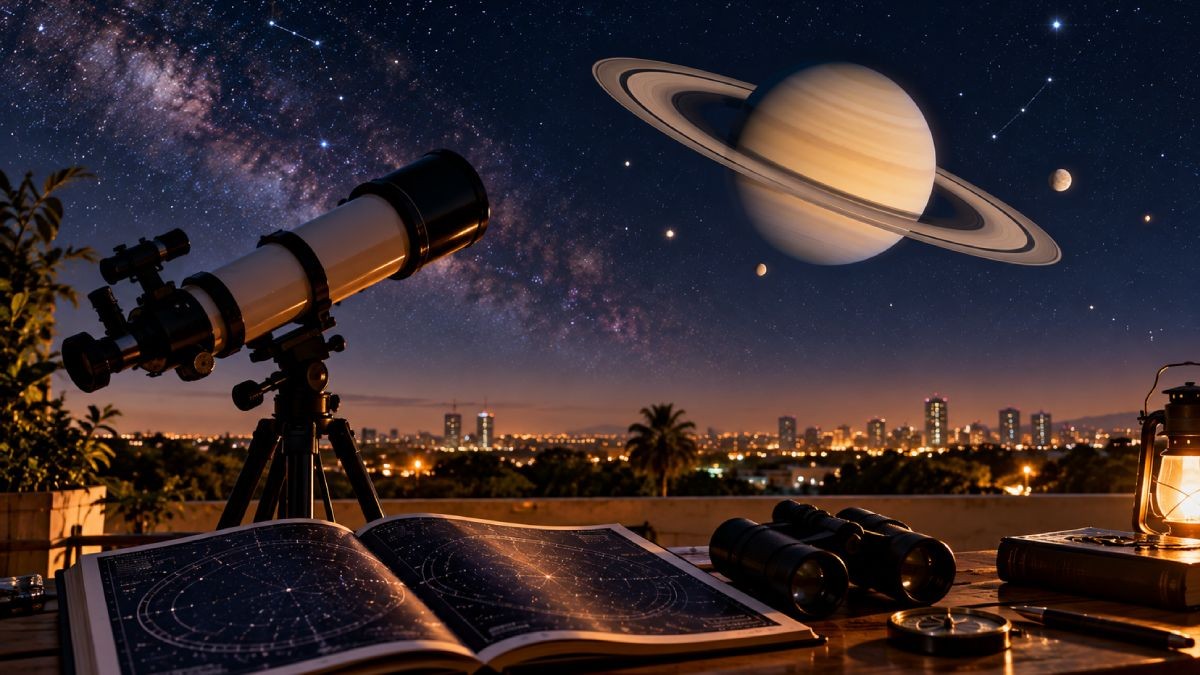
Saturn will reach opposition on October 4, 2026. Earth passes between the Sun and Saturn at opposition so that in the night sky Saturn will appear opposite the Sun. Saturn will be the brightest planet of the year and will be visible all night.
The event is particularly interesting because Saturn's famous rings will also be more favourably tilted compared with their almost edge-on appearance in 2025.
Related Articles


What does Saturn At Opposition mean?
Opposition occurs when an outer planet (such as Saturn) is located on the opposite side of the Earth from the Sun.
From our perspective, it means Saturn rises around sunset and remains in the sky for most or all of the night and sets around sunrise. And it comes to its closest point to Earth for the year around this period, so it seems larger and brighter.
Saturn will shine at magnitude 0.3 on opposition and will be bright enough to be seen without a telescope under proper conditions. It will seem a steady golden-coloured point of light rather than a rapidly twinkling star.
Related Articles
The opposition occurs on October 4, even if the best viewing time is between the day before and after the day of opposition.
Is Saturn visible from India?
Yes. Saturn will be visible from India during the October opposition.
The Indian Meteorological Department’s Rashtriya Panchanga visibility guide lists Saturn as visible throughout the night on October 4, the date of opposition. From October 5, it enters the evening sky and remains visible after sunset for several months.
For Indian skywatchers, the most useful period will be the night of October 4 and the surrounding days.
After sunset, look for Saturn in the eastern part of the sky. As the night goes on, Saturn will be visible from the eastern sky and be more visible so that it will become easier to see. Around local midnight, Saturn will be at its highest position in the sky.
The exact rising and setting times are different depending on the location, so observers can use a reliable astronomy or sky-map application to determine the location of Saturn from their city.
Can you see Saturn without a telescope?
Saturn itself can be seen with the naked eye.
It will appear like a bright, steady point of light, not a star with a big ring. The rings are too small to see with an unaided eye, so a telescope is necessary.
Even a small telescope could reveal Saturn's ring system. And in ideal conditions, the observer might be able to find some of Saturn's brighter moons.
The rings are especially intriguing this year because their orientation is becoming more favourable after Saturn's rings appeared almost edge-on from Earth in 2025. In our view around the October opposition, the rings will be tilted by about 7.5 degrees from our line of sight.
This makes the ring structure easier to distinguish through a telescope than it was during the near-edge-on period.
When is the best time to watch Saturn?
October 4 is the official opposition date, but skywatchers do not need to wait for that one moment.
Saturn will remain well-placed to see in opposition. The planet will rise around sunset, stay visible through the night and reach its highest point around midnight.
If you want to see better than you can from the bright city lights and buildings that block the horizon, find a location away from bright city lights and buildings that block the horizon. You need a clear and cloud-free sky.
When your eyes adjust to darkness, allowing your eyes to adapt can make the view of the stars more beautiful and the overall stargazing experience more enjoyable. It is also useful to avoid looking directly at bright phone screens while watching.
A telescope should be placed on a stable surface and then adjusted to the outdoor temperature before detailed planetary observation can take place. Atmospheric conditions can affect how clearly Saturn and its rings appear.
What can you see with a telescope?
With a small telescope, Saturn's rings should be the most obvious feature. The planet itself may appear as a small disc surrounded by the ring system.
Larger telescopes can also provide information - depending on the equipment and atmospheric conditions. This could include subtle bands on Saturn and some moons.
However, expectations should be realistic. The view of detailed structures such as the Cassini Division will depend on telescope aperture, magnification, atmospheric stability and observing conditions.
For casual skywatchers, seeing Saturn and its rings is such a nice little pleasure.
Why is October 2026 special for Saturn?
Saturn is at least once a year in opposition, and so it is not a rare event. But each opposition is a different experience because the distance of Earth from Saturn and the position of its rings change with time.
In 2026, Saturn will have its brightest and largest size of the year around the October opposition. This year’s improved ring angle makes it especially attractive to amateur astronomers.
The planet will still be visible after the opposition, but its position in the evening sky will gradually change.
On October 4, we may step outside after sunset and look for one of the most recognizable planets of the solar system.
Whether seen with the naked eye as a bright point or through a telescope showing its rings, Saturn's opposition will be one of the major skywatching highlights of October 2026.



Comments 0