
Independence Day is an opportunity for children to celebrate India's freedom while learning about the people who contributed to the country's struggle for independence. Many schools organize fancy-dress competitions, cultural programmes and special assemblies around August 15, giving children a fun way to connect with history.
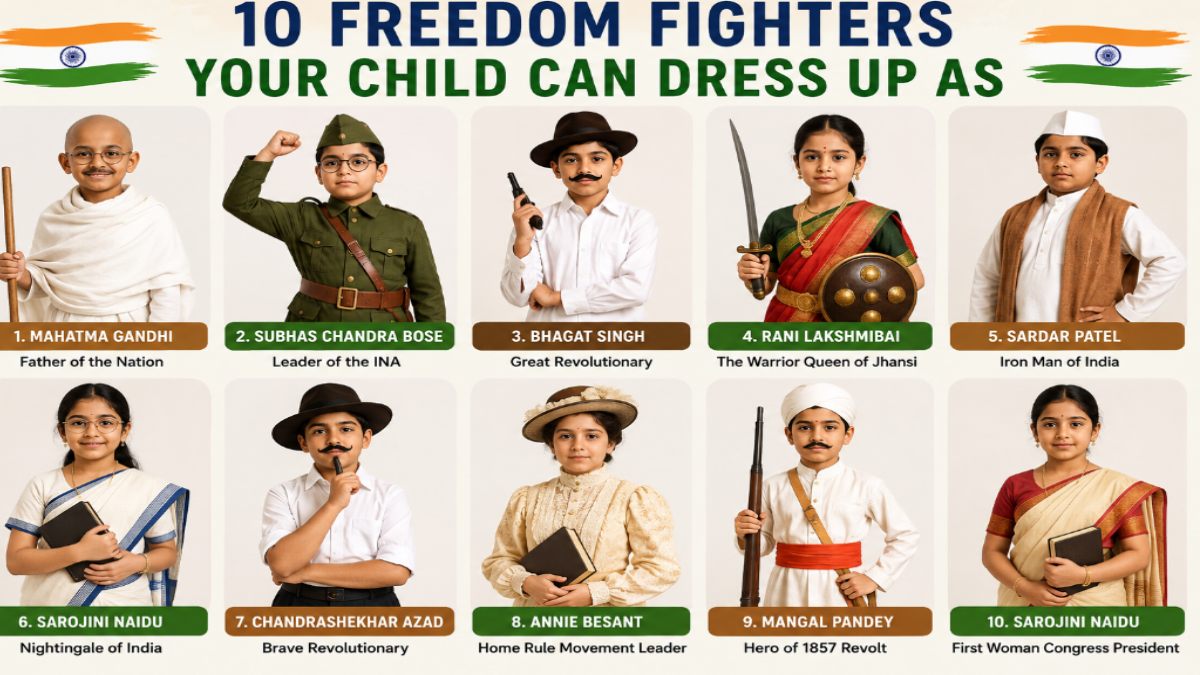
Instead of choosing a generic patriotic outfit, parents can help children dress as an important historical figure. A well-planned costume can become a conversation starter, allowing children to learn about the person's contribution and share a few lines about them during a school event.
Here are 10 inspiring freedom fighters and national figures children can consider portraying for Independence Day.
Related Articles
1. Mahatma Gandhi
Mahatma Gandhi is one of the most recognizable figures associated with India's freedom movement. He promoted non-violence and civil disobedience as important tools of resistance.
For a simple costume, children can wear a plain white dhoti or traditional white outfit and carry a pair of round spectacles. A walking stick can complete the look, with appropriate supervision.
Children can also say a short line about Gandhi's message of non-violence and truth.
Related Articles
2. Subhas Chandra Bose
Subhas Chandra Bose, popularly known as Netaji, played a significant role in India's independence movement and led the Indian National Army.
A child portraying Bose can wear a military-inspired outfit with a cap and spectacles. Parents should avoid unnecessary complexity and focus on recognizable elements of the character.
A short speech about courage, leadership and his contribution to the freedom struggle can accompany the costume.
3. Bhagat Singh
Bhagat Singh remains one of India's best-known revolutionary figures. He became a symbol of courage and sacrifice during the independence movement.
His iconic appearance can be recreated with a simple shirt, trousers, a moustache drawn appropriately for a costume and a vintage-style hat. Children can learn about his ideas and his role in the revolutionary movement while preparing their presentation.
4. Rani Lakshmibai
Rani Lakshmibai of Jhansi is an inspiring historical figure known for her resistance during the Revolt of 1857.
A child can wear a traditional saree-style costume with a dupatta and simple traditional accessories. A toy sword designed specifically for children's costumes can be used as a prop if permitted by the school and handled safely.
Her story can help children learn about courage and resistance.
5. Sardar Vallabhbhai Patel
Known as the “Iron Man of India,” Sardar Vallabhbhai Patel played a major role in India's political integration after independence.
Children can wear a simple traditional kurta and dhoti or a similar period-inspired outfit. A grey wig or moustache can be used for an age-appropriate theatrical effect.
His story provides an opportunity to discuss national unity and leadership.
6. Sarojini Naidu
Sarojini Naidu was a poet, political activist and important participant in India's freedom movement. She was also one of the prominent women leaders of the independence struggle.
A child can dress in a traditional saree with simple accessories. Parents can help them prepare a short introduction about her contribution to India's freedom movement and her literary legacy.
7. Chandrashekhar Azad
Chandrashekhar Azad was a revolutionary who became an important figure in India's independence movement.
A simple traditional or period-inspired outfit, along with a hat and carefully styled moustache, can create a recognizable costume. Children can focus their presentation on his determination and commitment to the freedom movement.
8. Annie Besant
Annie Besant was an influential political activist and supporter of India's Home Rule movement. She also made significant contributions to education and public life in India.
A child can portray her in a simple long dress or period-style outfit, with a shawl and accessories appropriate to the era.
Her story is particularly useful for showing children that India's freedom movement included people from diverse backgrounds.
9. Mangal Pandey
Mangal Pandey is remembered for his association with the Revolt of 1857, an important early challenge to British rule in India.
A child can wear a simple soldier-inspired costume suitable for a school event. The emphasis should be on historical learning rather than elaborate military props.
10. Sarojini Naidu
Sarojini Naidu's contributions make her a strong choice for a child interested in combining India's literary and political history. She was an influential voice in the national movement and became the first Indian woman to serve as president of the Indian National Congress.
For a costume, a colourful traditional saree with minimal accessories can work well. Children can recite a short passage about her life or explain why she is remembered as the “Nightingale of India.”
Make the Costume Educational
A fancy-dress event becomes more meaningful when children understand the person they are portraying. Parents can help them learn three simple things: who the person was, what they contributed and why their legacy is remembered.
Costumes do not need to be expensive. Many can be created using clothes and accessories already available at home. The focus should be on historical accuracy, comfort, safety and learning.
Most importantly, Independence Day should encourage children to appreciate India's history and understand that freedom was shaped by the contributions, sacrifices and struggles of many people.




Comments 0