
Nita Ambani once again showed her love for Indian craftsmanship, traditional textiles and cultural heritage when she turned up at Deepawali Utsav celebration.
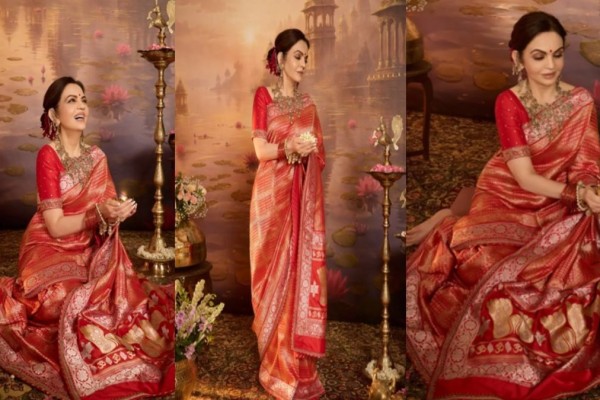
Not just the festive look or jewellery but a remarkable handwoven saree with a deeply spiritual story too caught everyone’s eyes! Nita wore Ramavali saree by Swadesh which was specially designed to celebrate devotion of Lord Ram as well as weaving traditions of Varanasi.
Made of pure silk, gold zari and silver zari it had sacred name ‘Shri Ram’ woven repeatedly on panels. The extraordinary craftsmanship, motifs and spiritual meaning made this outfit one of the most talked about aspects of her festive look.
Related Articles


Designed over five months by master artisan Ajay Bhoj, the saree represented coming together of India’s traditional textile heritage, religious symbolism and extraordinary handloom artistry.
The highlight of Nita Ambani’s outfit was the vermilion-coloured Ramavali saree with its intricate weaving and traditional design. The name Ramavali itself has a beautiful meaning as it is Ram (God) + Namavali (a garland of divine names). So true to its name the saree had ‘Shri Ram’ woven across panels so that a traditional garment became a celebration of devotion; printed designs or surface embellishment weren’t used instead sacred words were woven directly into fabric through handweaving every letter was created by an artisan, making the saree a wonderful example of patience, precision and dedication. It was inspired by Bengal’s Namavali textile heritage which incorporates sacred names and devotional elements in fabric.
One of the most fascinating aspects of the Ramavali saree was how it was woven. Master artisan Ajay Bhoj handweaved the saree in pure silk over five months using the traditional Kadwa weaving technique (specialised Banarasi weaving method where motifs are made separately, each one woven carefully into the fabric rather than through a brocade pattern).
Related Articles


Each flower, letter and decorative element was individually woven which takes time, skill and attention to detail it’s highly prized for its rich texture, durability and intricate appearance. Kadwa weaving meant that all the elaborate designs on the saree were woven into the silk itself so that Varanasi’s handloom tradition was fully integrated into the design.
The pallu of the Ramavali saree was another important aspect that gave spiritual depth to the overall design. It had footprints of Lord Vishnu surrounded by delicate lotus motifs a visual representation of devotion and divinity. The rest of the saree had floral patterns, Om sacred symbol and jaali work. Gold and silver zari enriched vermilion silk with richness of colour traditional colours against metallic detailing.
Every design element was planned keeping India’s religious and artistic traditions in mind. Swadesh says “We created the saree for the spiritual and artistic heritage of Varanasi which is known for its temples, religious traditions and centuries old silk weaving culture.”
Nita Ambani paired the elaborate saree with equally exquisite traditional jewellery. She wore a multi-string rani haar necklace with cascading seed pearls which made her festive look graceful and royal.
The necklace also had gold spacer bars (Rajasthan’s Thappa technique) and natural Polki diamonds added sparkle without drawing attention away from the saree craftsmanship. Pearls, gold and uncut diamonds showed how rich Indian jewellery making traditions are. Her choice of accessories showed us how traditional jewellery can work with heritage textile but still be sophisticated at a festive function.
The Ramavali saree also shows why India needs to preserve its weaving communities and indigenous textile techniques. Varanasi has always been famous for Banarasi silk sarees (luxurious fabrics, brocade patterns and zari work).
Generations of artisans have kept these traditions alive through specialised skills passed down within families and communities. Creations like the Ramavali saree show how traditional handloom techniques can be used to create meaningful contemporary designs without losing their cultural identity.
The five month weaving time also shows how much labour and artistic skill is required to produce an exceptional handcrafted garment unlike mass produced clothing they bear the individual effort and creative contribution of skilled artisans.
Swadesh’s Ramavali creation is particularly significant because it brings devotion, history and craftsmanship together in one garment. The repeated inscription of Shri Ram, footprints of Lord Vishnu, lotus motifs and sacred Om symbol give the saree a spiritual identity but its vermilion colour, silk fabric and zari detailing make it an elegant choice for grand festive celebration as well.
Nita Ambani wearing this creation at Deepawali Utsav also brought attention to work done by traditional Indian artisans and why indigenous craftsmanship should be supported.
Overall Nita Ambani’s Ramavali saree was so much more than a festive fashion statement. It was an ode to India’s spiritual heritage; the weaving culture of Varanasi; the dedication of master artisans and five months spent in weaving pure silk fabric every detail was extraordinary artistry.
The Kadwa technique had been used individually to craft motifs on her pearl & Polki diamond rani haar too. At a time when fashion trends change all the time, Ramavali saree showed us how centuries-old textile traditions of India are relevant, meaningful and beautiful too.




Comments 0