
India’s tuberculosis (TB) mortality has fallen by 38% in the past decade (from 2015 to 2025), higher than global decline of 35% during that period, according to the WHO Global Tuberculosis Report 2026.
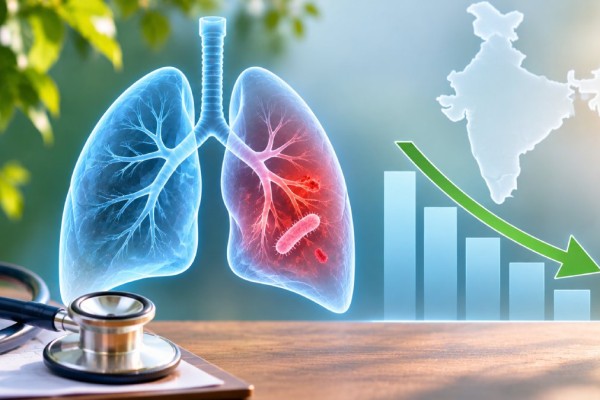
The report (released on 12 November 2026) shows that India has made progress in tuberculosis prevention, early detection and treatment. Union Health Ministry said improvement was due to intensified screening programmes, diagnostic facilities, timely treatment and nutritional support for patients.
India’s estimated TB mortality rate fell from 28 deaths per lakh population in 2015 to 18 deaths per lakh population in 2025. India had a 94% treatment success rate among patients with drug-susceptible tuberculosis.
Related Articles


However, tuberculosis is still a major public health problem in India (so sustained screening, access to treatment and community participation are key priorities).
India's TB Mortality Declines by 38% Between 2015 and 2025
As per WHO Global Tuberculosis Report 2026 India saw a 38% reduction in TB mortality over the last decade (2015-2025).
The decline was above the global reduction of 35%, which suggests that the country was making progress in reducing deaths from the infectious disease.
Related Articles


The estimated TB mortality rate in India declined from 28 deaths per lakh population in 2015 to 18 deaths per lakh population in 2025.
The Health Ministry said the improvement is due to interventions under the National TB Elimination Programme (NTEP) — proactive screening, rapid diagnostic tests, early treatment initiation and patient support programmes.
The WHO report also uses epidemiological surveillance and multiple data sources to improve estimates of tuberculosis-related mortality in India.
TB Mukt Bharat Abhiyaan Reaches Over 25 Crore People
The government’s TB Mukt Bharat Abhiyaan has been instrumental in expanding tuberculosis screening across the country.
The Health Ministry said the intensified screening campaign covered more than 25 crore people. During the initiative healthcare teams did more than 11 crore chest X-rays and more than 3 crore molecular diagnostic tests.
The programme identified 48.64 lakh TB cases (14.97 lakh asymptomatic cases).
People with TB who don’t have symptoms are particularly hard to spot because the disease may not be detected otherwise. Early detection enables healthcare professionals to assess patients and start treatment.
The screening initiative has targeted high priority districts, vulnerable populations and communities where health services may be less available.
These efforts are aimed at earlier diagnosis and less delay in treatment.
AI-Based Technology Strengthens TB Detection
Technology and improved diagnostic facilities are becoming more important in India’s tuberculosis elimination efforts.
The National TB Elimination Programme has used AI-enabled chest X-rays and rapid molecular diagnostic technologies to support early detection.
AI-based screening tools can be used to identify suspicious abnormalities in chest X-ray images and prioritise those who need further testing.
The government is also using technology to pinpoint disease hotspots and predict patients who might be at higher risk of adverse treatment outcomes.
Digital platforms such as Ni-kshay track patients, monitor treatment and manage programmes.
Other initiatives such as Khushi AI chatbot and Avatar Videobot are being used to increase communication and awareness around tuberculosis.
These technologies are meant to help healthcare professionals and extend screening and patient care services (where access to advanced diagnostic facilities may not be possible).
India Records 94% TB Treatment Success Rate
Along with the fall in mortality, India has also reported a 94% treatment success rate among patients with drug-susceptible tuberculosis.
The treatment success rate shows how important it is to diagnose early, have access to appropriate medicines, monitor regularly and continue supporting patients afterwards.
Tuberculosis is usually treatable with the right course of medication. Patients need to complete their prescribed treatment to reduce risk of treatment failure, relapse and drug resistance.
The government has also strengthened patient-support initiatives to address challenges related to prolonged treatment.
Nutritional support is part of this approach too since undernutrition increases susceptibility to tuberculosis and makes recovery more difficult.
Ni-kshay Poshan Yojana Provides Nutritional Support to TB Patients
Financial and nutritional support programmes are another component of India’s TB control strategy.
Under Ni-kshay Poshan Yojana TB patients eligible for financial assistance to meet nutritional requirements during treatment are given money.
Ni-kshay Mitra initiative also encourages individuals, organisations, institutions and community members to support people with tuberculosis.
These initiatives are designed to reduce financial and nutritional difficulties that patients may face during treatment.
Nutrition, medical supervision and adherence to medicines prescribed are important for recovery.
The government has also encouraged community participation through local institutions, healthcare workers and civil society organisations to raise awareness and support for TB patients.
India Still Faces a Significant TB Burden
While the fall in TB mortality is progress, India still bears a large share of the global burden of tuberculosis.
In 2025 WHO estimated that India represented about 25% of global TB cases.
The figures show that controlling tuberculosis is not easy even though diagnosis and treatment are improving.
India was among the eight countries (2025 TB cases: two-thirds) that the WHO report identified in the world. The other seven are Indonesia, Philippines, China Pakistan Nigeria Democratic Republic of Congo Bangladesh.
Drug-resistant tuberculosis is another problem. It requires more complex treatment and ongoing medical supervision so early diagnosis and appropriate treatment are particularly important.
The WHO also said India’s TB incidence estimates are under review. Findings from a nationally representative TB prevalence survey conducted in 2025 by Indian Council of Medical Research’s National Institute for Research in Tuberculosis (ICMR-NIRT) have been shared with WHO and technical discussions are ongoing.
After review a new country profile is expected.
WHO Reports 35% Decline in Global TB Deaths
The WHO Global Tuberculosis Report 2026 also shows that deaths from tuberculosis are declining worldwide.
10.6 million people got TB in 2025 globally and about 1.13 million died from it.
Global TB deaths fell 35% between 2015 and 2025. The WHO said that was the first mortality milestone reached under its End TB Strategy (five years later than planned).
Deaths have fallen but new TB cases have declined more slowly. The global incidence rate of TB fell by about 14% between 2015 and 2025.
The WHO has stressed the need for continued domestic investment, better access to healthcare services and stronger efforts to prevent new infections.
What is Tuberculosis and Why Is Early Detection Important?
Tuberculosis is an infectious disease caused by bacteria Mycobacterium tuberculosis. It usually affects the lungs but can also affect other parts of the body.
Pulmonary TB spreads through the air when someone with infectious TB coughs, sneezes or spits.
Common symptoms of pulmonary tuberculosis are:
Pulmonary tuberculosis is a disease of the lungs. It can be caused by bacteria called Mycobacterium tuberculosis. Symptoms include coughing up blood (hemoptysis), weight loss, night sweats, fever and fatigue.
- Persistent cough lasting several weeks.
- Chest pain.
- Coughing up blood or sputum.
- Fever and night sweats.
- Unexplained weight loss.
- Loss of appetite.
- Fatigue and weakness.
However some people with TB have no obvious symptoms so screening is important for those at higher risk.
TB can be diagnosed by medical evaluation, sputum testing, chest X-rays and molecular diagnostic tests depending on the condition of the patient.
The disease is generally curable with treatment. Patients need to follow medical advice and complete their medication (not stop when symptoms improve).
If you have TB symptoms, don’t try to diagnose yourself. See a doctor instead.
Final Takeaway
The 38% decline in tuberculosis-related deaths since 2015 is an important achievement for India’s public health efforts. The reduction (which exceeds the global decline of 35%) reflects improvements in screening, diagnosis, treatment and patient support programmes.
The 94% treatment success rate and large scale screening programmes also show progress under the National TB Elimination Programme.
Still India’s continuing burden on the global TB total shows that more work needs to be done. Expanding early diagnosis, increasing access to treatment; tackling drug-resistant TB and nutritional support will all remain central to TB-free India.




Comments 0