
Lord Vishnu is the preserver of the universe he comes down to earth whenever evil threatens balance of righteousness. Of his ten avatars (incarnations), Lord Rama is special because he is the seventh incarnation. Unlike some of Vishnu’s other manifestations, Rama chose to live as an ordinary human being responsibilities, struggles and limitations all part of mortal life.
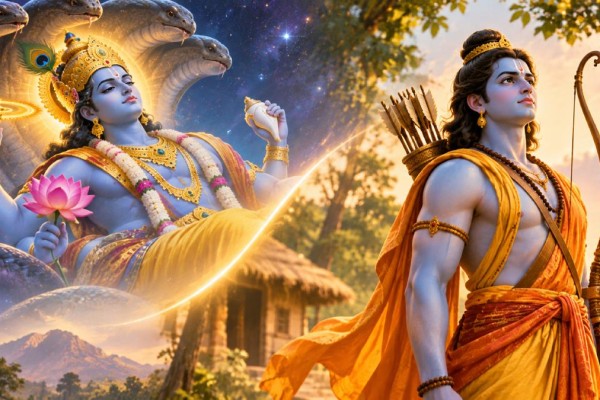
The story of his birth is linked to the growing power of Ravana, demon king of Lanka whose extraordinary powers had become a threat to the three worlds. The gods went to Lord Vishnu for help in Ramayana (the story of Ayodhya). He decided to take birth in royal family of Ayodhya.
But the deeper significance of Rama’s incarnation is not just defeating Ravana. His life shows us how righteousness, self-control, duty and compassion can guide human beings even in the most difficult circumstances.
Related Articles

Why Did Lord Vishnu Take Birth as a Human?
Ravana had undergone severe penance to please Lord Brahma and received a powerful boon that made him invulnerable to gods, celestial beings and several other supernatural creatures (Ramayana).
However, Ravana did not realise that humans exist and so when he asked for the boon he did not seek protection against them.
His increasing arrogance and misuse of power caused suffering in all three worlds. The gods came to Lord Vishnu eventually, asking how to end Ravana’s tyranny.
Related Articles


Vishnu realized that Ravana’s boon made him vulnerable to a human opponent. So he took human birth as the son of King Dasharatha of Ayodhya.
This enabled Vishnu to defeat Ravana without breaking the conditions of Brahma’s boon.
The decision was not about defeating a strong enemy but also Dharma (righteousness) through the actions and choices of a human life.
The Significance of Ravana's Boon in Rama's Birth
Ravana’s boon determined the form Vishnu would take for his incarnation.
After receiving protection from Brahma Ravana became more confident in his power. He believed that no divine or supernatural force could defeat him.
However, his request for protection did not include human beings because he thought them insignificant compared with the other powerful beings of the universe.
This was the weakness that would eventually bring him down.
Lord Vishnu’s decision to become a human being was therefore linked to the conditions of Ravana’s boon.
The story has a broader message about arrogance and overconfidence. Ravana thought he was invincible so couldn’t see that an ordinary human form could defeat him.
Why Did Lord Ram Live Like an Ordinary Human?
One of the most important aspects about Rama’s incarnation was that he went through many things which ordinary human beings have to go through.
Although Rama was considered an incarnation of Vishnu he didn’t just use divine powers to get out of every difficulty; family responsibilities, personal sacrifices, separation from loved ones and moral dilemmas were part of the journey.
When Kaikeyi demanded that Rama be sent into exile for fourteen years Rama accepted the decision rather than resist his father’s promise.
During his exile he lived in forests, he had dangerous enemies and his wife Sita was abducted.
His way to Lanka required him to get the help of Sugriva, Hanuman and Vanara army.
These experiences made Rama’s story different from a divine figure who appears, defeats evil and disappears.
Instead his life showed how a person could stick to principles even when the circumstances weren’t good.
Maryada Purushottam: The Ideal of Human Conduct
Lord Rama is also known as Maryada Purushottam (righteous conduct and moral principles).
The title refers to his example of discipline, responsibility and ethical behaviour.
Throughout the Ramayana Rama is faced with situations where his personal desires are in conflict with his responsibilities.
Some important aspects of his character include:
- As a son: Rama takes his father’s word and agrees to spend fourteen years in exile though he is on the verge of becoming king.
- As a brother: His relationship with Lakshmana and Bharata is one of loyalty, affection and mutual respect.
- As a husband: His journey to save Sita from Ravana shows his commitment to bring her back from captivity.
- As a ruler: Rama’s return to Ayodhya and Ram Rajya are traditionally associated with just governance, prosperity and welfare of citizens.
Through these different roles Rama represents the idea that Dharma has to be practised through everyday actions and responsibilities.
Why didn’t Vishnu just destroy Ravana with his divine powers?
A natural question from the story is why Vishnu had to take human birth when he could defeat Ravana directly?
The answer is in the conditions of Ravana’s boon and in the deeper purpose of incarnation itself.
Since Ravana had protection from gods and supernatural beings, Vishnu’s human incarnation gave him a way to break through that protection.
But the decision also had a philosophical dimension.
By taking human form Vishnu showed that righteousness is not only about extraordinary powers. Courage, discipline, loyalty and determination can also be powerful forces against injustice.
Rama’s journey shows that someone who is going through difficult times can still be committed to Dharma.
His victory over Ravana therefore is both defeat of evil and restoration of moral order.
The Difference Between Lord Rama and Other Avatars of Vishnu
Vishnu is traditionally associated with ten main avatars (Dashavatara). Each incarnation is linked to a different purpose of maintaining cosmic balance.
Rama’s seventh avatar is especially significant because divinity is shown through the life of an ideal human being.
Narasimha appears in fierce half human, half lion form to slay Hiranyakashipu; Vamana takes the form of dwarf to restore balance against King Bali.
Krishna (the eighth avatar) displays divine wisdom, diplomacy and spiritual knowledge (Bhagavad Gita).
Rama’s incarnation is, in contrast, closely associated with duty, restraint, honour and righteous leadership.
His life shows how Dharma can be lived out through personal choices, family relationships and responsibilities towards society.
What Is the Deeper Spiritual Meaning of Lord Rama’s Human Incarnation?
The story of Rama’s incarnation has several philosophical interpretations within Hindu traditions.
One of its central messages is that preserving Dharma takes more than defeating external enemies. It also requires people to control their desires, fulfil their responsibilities and remain ethical.
Rama’s acceptance of exile, his determination to rescue Sita and his eventual return to Ayodhya are all different dimensions of this idea.
His life also shows how divine purpose relates to human experience.
Even though Rama is worshiped as an incarnation of Vishnu, it is through his earthly life that devotees learn spiritual truths in situations familiar to human life.
This is one reason why the Ramayana continues to have an impact on religious practices, literature, art and cultural traditions in India and other parts of Asia.
Why Lord Ram's Story Continues to Matter Today
The story of Lord Rama is still relevant because its central themes are not limited to the events of Ramayana.
His journey asks questions about personal responsibility, leadership, family relationships, justice and how moral values are maintained in difficult situations.
Ram Rajya is also often associated with the ideal of governance in which justice, welfare and public responsibility are important.
For devotees Rama is an ideal for devotion and emulation. His human incarnation also shows how divine principles can be lived out in everyday life.
So Lord Vishnu’s seventh avatar was not just about defeating Ravana. It was also about showing Dharma works through human conduct.
By choosing to live as a mortal Vishnu showed us that even the most difficult circumstances could become opportunities for truth, duty and moral responsibility.




Comments 0