
Introduction
What if space and time, the two basic structures through which human beings experience reality, are not so absolute as they appear? Swamiji talks about God, consciousness, space, time and the world outside of them in a deep philosophical discussion of existence. Drawing on Vedantic thought, he contends that Pure Being does not depend on space and time to exist but in reality space and time are appearances caused by the externalising movement of consciousness.
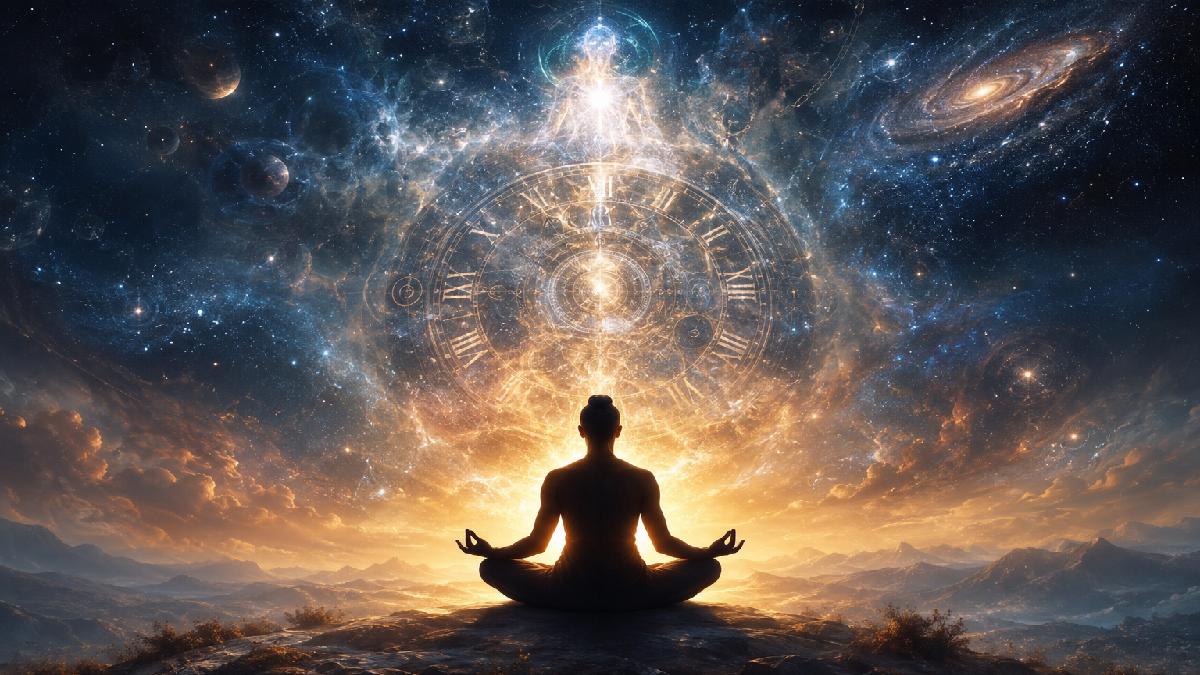
In this perspective, is the world the way we see it or does our consciousness do so much of the work of creating reality?
God Beyond Space and Time
The Vedantic perspective of Swamiji states that God or the Absolute existed even before space and time. If the Supreme Being can exist without space and time, then space and time cannot be necessary conditions for existence itself. They belong to the realm of perception rather than to Pure Being.
Related Articles

From this point of view, space and time are externality. They make it possible for consciousness to experience something as being separate, distant, earlier, later, inside or outside. Pure Being is, in fact, externality free. It is complete in itself and does not need to be a different thing from what it is already.
This idea is a challenge to the basic human assumption that everything must exist somewhere and at some particular moment. It asks if these categories are in reality or only in the way our limited consciousness perceives reality.
The Dream Analogy
One of the best ways to understand this idea is to use the dream as an example. A person can dream out all the world around them while dreaming. There might be landscapes, people, buildings, movement, distance and time. The dreamer can see objects that seem like they exist outside of themselves.
Related Articles
But when the person wakes the whole dream world is recognized as a projection of consciousness. The space and time experienced in the dream did not exist independently in the way the dreamer assumed.
Swamiji uses this analogy to explain the waking experience. Just as dream consciousness appears to create an external world, human consciousness may similarly experience reality through a framework of space, time and separation.
The key point is that consciousness itself is the subject. It can't become an external object literally because it is the very principle through which objects are known. Externality therefore is a fundamental change in perception.
Why the World Appears Real
If the world in comparison to a dream is just that, then why does it feel so real?
The answer is in our involvement with it. A person dreaming cannot ordinarily stand outside the dream and objectively evaluate it. The dreamer, the dream world and the experiences within it form one structure.
The same concept can be applied philosophically to waking consciousness. Human beings are not detached observers standing outside of the universe. We are as much as we are in the very reality we want to understand.
This is a deep limitation. We attempt to judge the nature of the world using the same consciousness that is already conditioned by perceptions of space, time, individuality and externality.
Swamiji illustrates this with the analogy of a judge who is also the client in the case. If the judge is personally involved in the matter being judged, complete impartiality becomes impossible. Similarly, human beings may struggle to understand the ultimate nature of reality because they are themselves embedded within the structure they are trying to examine.
The Absolute and the Idea of Becoming
Vedantic philosophy makes an important distinction between Being and becoming. Becoming implies change, transition and movement from one state into another. Something is different from what it was before.
The Supreme Being, however, cannot become a thing other than itself. If the Absolute were to actually transform into something else, it would no longer be Absolute in the complete sense.
This is why the appearance of an external world is described as an appearance rather than a literal transformation of the Absolute. The Absolute is all that is, while limited consciousness experiences multiplicity, separation and change.
The result is the familiar world of perception: countless individual beings, objects in different places and events at different moments.
Space, Time and Modern Physics
We can also compare it with developments in modern physics, particularly in relativity and quantum mechanics. Modern physics has fundamentally challenged the idea of space and time as completely independent and absolute concepts.
Einstein's theory of relativity also demonstrated that the measurement of space and time depends on the observer's motion and the gravitational environment. We see space and time as interwoven components of spacetime, and not as separate, independent things.
Quantum mechanics has also challenged intuitive beliefs of observation, measurement and physical reality. But we must not conclude that modern physics just confirms the metaphysical claims of Vedanta. Physics and Vedantic philosophy are different and deal with different kinds of questions.
The comparison is intellectually stimulating. Both traditions require us to question the assumptions about reality that are apparent from everyday life.
Yoga as a Way Beyond Externality
In the discussion, intellectual analysis alone cannot solve the problem since the intellect itself is situated in our own perception. If consciousness is deeply connected to the external world, simply thinking about transcendence might not be enough.
And here yoga and meditation come in. Yoga is not just a physical exercise but also a spiritual discipline through which consciousness can gradually move beyond its habitual identification with individuality and externality.
The goal is to reach a more universal dimension of consciousness in which the sharp division between subject and object is transcended. It could be that the question of the external world is lost as consciousness is no longer experiencing reality exclusively through separation and particularity.
The Wisdom of Yoga Vasishtha
Swamiji also refers to the Yoga Vasishtha, an important Indian philosophical text to study consciousness, perception, reality, dreams and the nature of the world.
The text has long used dream-like experiences and the relativity of perception to provoke readers to question conventional thinking about reality. Its philosophical thinking is rooted in spiritual inquiry as opposed to experimental science.
The link with modern scientific thinking is thus best understood as a philosophical comparison. Both can provoke questions about whether in our everyday perception we have a complete picture of reality even though they are not the same.
The Meaning of Samsara
The Vedantic concept of *samsara* is also of great interest. Samsara refers to the notion of entanglement in life in general and to the identification with individuality, desire, change and the cycle of experience.
Human beings are already immersed in this, and recognition of the entanglement is difficult. We experience the world through the very frame Vedantic philosophy asks us to examine. The spiritual path is thus to become more aware of how consciousness creates divisions between self and other, subject and object, here and there, past and future.
A Question Worth Contemplating
The appearance of space-time ultimately raises a question much larger than physics alone: What is reality when perception has been removed from its limitations?
The Vedantic answer is Pure Being and Consciousness as the basic reality, while space, time and externality are conditioned experience. The world seems real to the individual because the individual is part of the same structure through which that world is perceived.
Whether it’s meditation, philosophical inquiry or contemplation, the question remains present. Perhaps the purpose is not to deny the daily reality but to investigate the consciousness through which reality is experienced.
In this sense, understanding space and time is part of a much larger spiritual inquiry: Who is experiencing them? And what happens when consciousness moves beyond the confines of limited perception?
The question, as Swamiji explains, is not just academic. It touches the purpose of human life and asks us to consider existence with patience, impartiality and deep thought.


Comments 0