
Have you ever wondered what the universe is made of? Modern science has been about atoms, molecules, energy, gravity and basic forces of nature. Jain philosophy, however, has a very different perspective on matter-life: that existence is not a collection of physical particles but the result of the interaction of six eternal things called Dravyas. According to Jain cosmology, they are the whole universe and explain consciousness, matter, motion, rest, space and time.
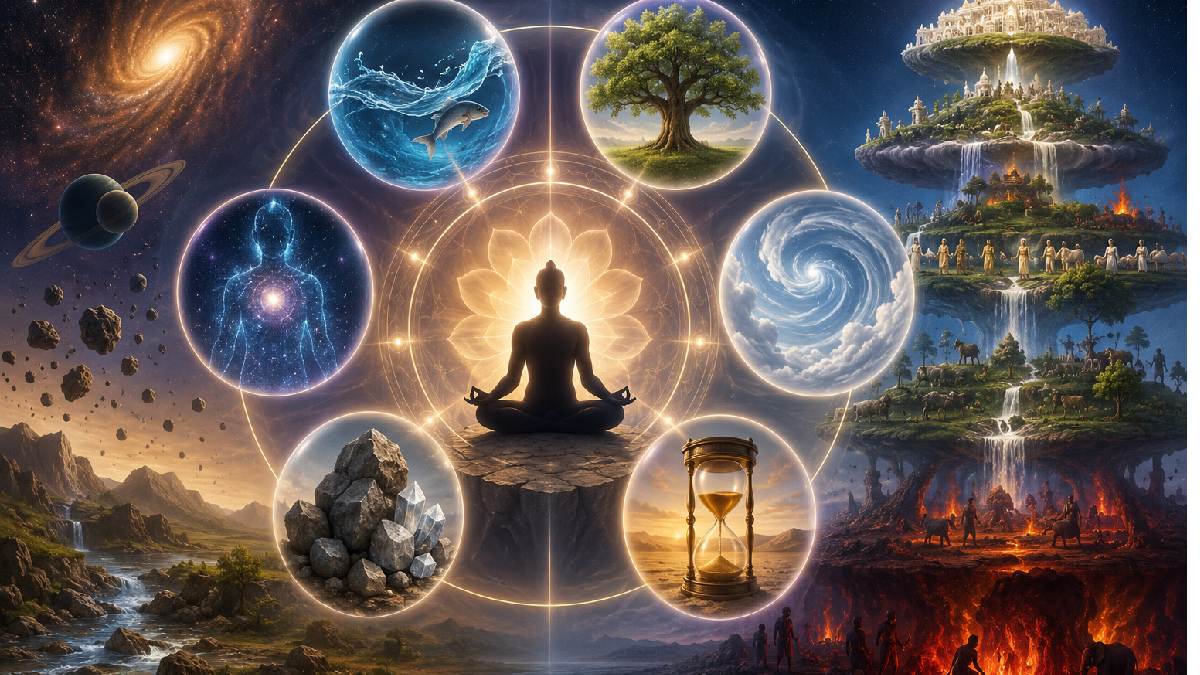
But unlike temporary objects that are born, changed and destroyed, these six items are eternal, and never cease to be. They neither cease to exist nor change. They always change in their states while still being very much them.
1. Jiva (Consciousness)
Related Articles

It is the first and perhaps the most important substance from Jiva, the conscious principle or soul. Everything from humans and animals to insects and tiny organisms has a soul. Jainism states that there are infinite souls and infinite knowledge, perception, bliss, and energy.
Jiva, unlike physical matter, is conscious, aware and can experience pleasure, pain, and spiritual development. Liberation (Moksha) in Jain philosophy is achieved when the soul becomes free from karmic bondage and realizes its pure nature.
2. Pudgala (Matter)
Related Articles
The second substance is Pudgala, or matter. The word is derived from two Sanskrit roots: Pud, meaning "to combine" and Gala, meaning "to disintegrate." This describes perfectly the cycle of formation and breakup in our world.
Everything we have physical form of (be it our bodies, mountains, water, air and even microscopic particles) is made of Pudgala. Matter is constantly changing by being formed into small and large parts and then breaking up into smaller parts.
3. Dharma Dravya (The Medium of Motion)
In Jain philosophy, Dharma Dravya does not refer to religion, ethics, or righteousness. It is the subtle medium that allows movement in the universe.
A common analogy is that of water helping a fish swim. The water allows movement but does not force the fish to swim. Similarly, railway tracks allow a train to move without forcing the train to move on its own. Dharma Dravya merely gives the necessary conditions for movement, whether it is a living being walking or a particle moving through space.
4. Adharma Dravya (The Medium of Rest)
Moreover, in combination with Dharma Dravya, is Adharma Dravya, which allows rest. Again, the word does not mean sin or immorality, but rather it is the condition that can bring moving things to a halt.
A classic analogy is the shade of a tree. The shade won’t make a traveler stop, but it does provide a means and support for rest. Adharma Dravya enables stillness without forcing it.
Dharma and Adharma Dravya are able to maintain balance between movement and rest throughout the universe.
5. Akasha Dravya (Space)
The fifth eternal substance is Akasha, or space. Space provides a place for all other substances to exist. Without space, there would be no place for souls, matter, movement, rest or time to exist.
Jain philosophy divides space into two regions:
Lokakasha, where all six dravyas coexist and where life, matter, motion, and time exist. Alokakasha, an infinite expanse beyond the universe that contains only space. It is void of souls, matter, motion, rest and time.
This makes Jain cosmology unique among the old philosophical systems.
6. Kala Dravya (Time)
The sixth and final substance is Kala, or time. Time is what makes change possible. Every object undergoes transformation— a new building ages, a fresh flower withers and living beings go through different phases of life.
Kala is not the author of change but is the background that allows transformation to occur. There is also a common analogy that sunlight provides photosynthesis without the plant actually producing it.
Without time, there would be no sequence of events, no growth and no decay.
The Universe as the Union of Six Dravyas
Jain cosmology states that the universe is the coexistence of these six eternal substances: Jiva, Pudgala, Dharma, Adharma, Akasha, and Kala. Every point in the inhabited universe contains all six simultaneously.
This inhabited universe is known as Lokakasha and is divided into Teen Lok (Three Realms):
The Lower World (Adho Lok). The Middle World (Madhya Lok). The Upper World (Urdhva Lok).
These are all heavenly beings, humans, animals, plants, infernal beings, celestial regions, and liberated souls. Beyond Lokakasha is Alokakasha, where only space exists.
In the Middle World lies Jambu Dweep, followed by Bharat Kshetra, and within Aryakhanda, the place where humans can discern right from wrong and pursue spiritual liberation. Jain texts claim our current human civilization is in this region.
Why the Six Dravyas Matter Today
The doctrine of the six dravyas offers more than a very ancient theory of the cosmic world. It is a philosophical stance in which consciousness is seen as fundamental, and not as a product of matter. It also regards the existence of motion, rest, space, and time as distinct realities.
Whether perceived as spiritual philosophy or cosmological theory, the six dravyas will bring about a deeper understanding of reality. And we’re reminded that existence is not about matter only but about many deep-seated principles in harmony. This perspective, which still inspires philosophical inquiry, ethical reflection and spiritual practice in people of Jainism and people with an interest in India’s intellectual traditions, remains the basis of the world.


Comments 0